
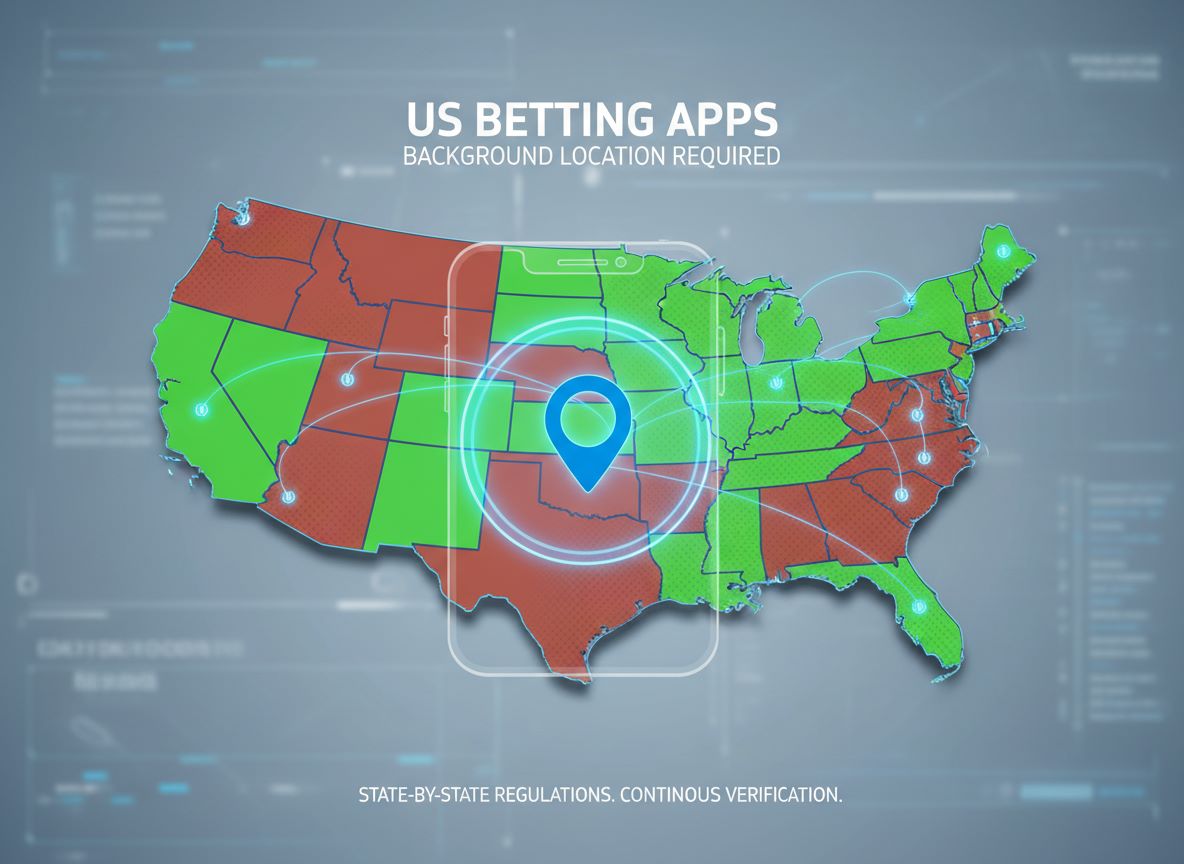
With over 68 million Americans now placing sports bets through mobile apps, one question consistently puzzles users: why do these platforms demand background location access? The answer lies in complex state-by-state regulations that require operators to verify each bettor’s physical location continuously. Unlike simple one-time checks, betting apps need background access to monitor your whereabouts throughout entire gambling sessions, ensuring compliance with strict geographic restrictions that vary dramatically across state lines.
This technological requirement stems from the intricate legal framework governing sports betting, where crossing state boundaries—even virtually—can trigger federal violations. Modern geolocation systems perform hundreds of verification checks per session, creating a sophisticated web of fraud prevention and regulatory compliance that extends far beyond basic location services.
Legal Reasons for Location Verification
The legal landscape surrounding sports betting location verification traces back to the 2018 Supreme Court decision that struck down PASPA (Professional and Amateur Sports Protection Act), returning sports betting regulation to individual states. This patchwork system created a complex web where each state maintains sovereign control over who can bet within its borders, making continuous location monitoring a legal necessity rather than a convenience feature.
Gaming commissions across legal betting states have established strict licensing requirements that place the burden of geographic compliance squarely on operators. These mandates require real-time verification that users remain within authorized boundaries throughout their betting sessions, with violations potentially resulting in massive fines or license revocation. The Wire Act further complicates matters by prohibiting interstate gambling transmissions, meaning even momentary location failures can trigger federal compliance issues.
State Licensing Compliance
State gaming authorities impose comprehensive geographic restrictions that vary significantly across jurisdictions, creating a complex compliance matrix for operators:
- New Jersey permits betting statewide with offshore account linking capabilities for residents
- Pennsylvania restricts certain bet types near college campuses and sporting venues
- Illinois prohibits betting on in-state college teams regardless of location within the state
- Nevada requires physical presence verification for mobile account funding in many cases
- Texas and Utah maintain complete sports betting prohibitions with criminal penalties
- California allows limited tribal betting with complex territorial restrictions
Operators face immediate license suspension risks if their geolocation systems fail to prevent unauthorized betting from restricted areas or states. Gaming commissions conduct regular audits of location verification logs, with penalties reaching millions of dollars for compliance failures.
Federal Restrictions
The federal Wire Act of 1961 creates an overarching legal framework that supersedes state regulations by prohibiting the transmission of betting information across state lines. This means that even if two adjacent states both allow sports betting, a bettor physically located in one state cannot legally place wagers with an operator licensed in the neighboring state.
No federal legislation currently overrides these interstate restrictions, leaving operators vulnerable to federal prosecution if their systems fail to prevent cross-border betting activity. The Department of Justice has consistently maintained that any gambling transmission that crosses state boundaries violates federal law, regardless of the legal status of betting in both states involved.
How Geolocation Technology Works
Modern sports betting platforms employ sophisticated geolocation technology that combines multiple verification methods to pinpoint user locations with remarkable precision. Leading providers like GeoComply utilize advanced algorithms that cross-reference various data sources, performing over 350 individual checks during each betting session to ensure regulatory compliance.
| Method | How It Works | Device Type | Accuracy Notes |
|---|---|---|---|
| GPS Satellites | Direct satellite positioning with triangulation | Mobile devices primarily | Most accurate outdoors, 3-10 meter precision |
| Wi-Fi Network Mapping | Matches network signatures to known locations | All connected devices | Highly accurate indoors, building-level precision |
| IP Address Geolocation | Maps internet provider data to geographic regions | Desktop and mobile | City-level accuracy, easily spoofed |
| Cellular Tower Triangulation | Uses signal strength from multiple towers | Mobile devices only | Variable accuracy, 100m-several kilometers |
| Device Fingerprinting | Analyzes hardware signatures and behavior patterns | All devices | Fraud detection tool, not location-specific |
Background vs Foreground Access
Background location access enables betting apps to continuously monitor user positions throughout entire gambling sessions without requiring the app to remain actively open on screen. This persistent monitoring ensures that if a user travels outside authorized boundaries during active betting, the system immediately detects the violation and suspends wagering capabilities until location compliance is restored.
When geolocation verification fails during background monitoring, most platforms automatically disable betting functions and display location error messages upon the user’s return to the app. This immediate response system prevents potential regulatory violations that could occur if users unknowingly place bets while outside authorized jurisdictions.
Why Background Access Specifically
Background location access serves as the cornerstone of regulatory compliance for sports betting platforms, enabling continuous verification that users remain within authorized boundaries throughout their entire betting experience. Unlike foreground-only access that checks location solely when the app is actively open, background monitoring provides real-time protection against geographic violations that could occur when users multitask or travel while maintaining active betting sessions.
This persistent monitoring system performs periodic location checks every few seconds during active sessions, immediately flagging suspicious patterns such as rapid location changes that might indicate GPS spoofing or VPN usage. The technology ensures that every wager placed receives real-time geographic verification, preventing operators from inadvertently accepting bets from unauthorized locations.
Modern betting platforms utilize background access to maintain comprehensive audit trails that satisfy gaming commission requirements for location verification documentation. These detailed logs prove regulatory compliance during investigations and help operators identify potential fraud attempts before they result in legal violations.
Continuous Verification Needs
The betting session verification process requires multiple sequential location confirmations to ensure ongoing compliance with state regulations:
- Initial location verification occurs during app launch and login authentication
- Secondary confirmation triggers when users navigate to betting interfaces or account funding
- Periodic background checks continue throughout active sessions, typically every 30-60 seconds
- Real-time verification occurs immediately before each individual wager placement
- Final location confirmation happens during withdrawal requests and account closure
This multi-layered approach ensures that location compliance extends beyond simple login verification to encompass every aspect of the gambling experience, from account management to actual bet placement.
Session Monitoring
Advanced session monitoring systems analyze location data patterns to identify potentially fraudulent activity, such as impossible travel speeds between location pings or sudden jumps between distant geographic coordinates. These algorithms flag suspicious location shifts that exceed realistic travel times, triggering additional verification requirements or temporary account restrictions.
The monitoring technology also tracks device behavior patterns, comparing current location data against historical user patterns to identify anomalies that might indicate account compromise or unauthorized access attempts. This comprehensive approach protects both operators and legitimate users from the legal consequences of geographic violations.
Desktop vs Mobile Differences
Location verification technology varies significantly between desktop and mobile platforms, with each presenting unique challenges and capabilities for accurate geographic positioning. Mobile devices offer superior location accuracy through built-in GPS capabilities, while desktop systems rely primarily on network-based positioning that can be less precise but more difficult to spoof.
| Platform | Tech Used | Requirements | Common Issues |
|---|---|---|---|
| Mobile Apps | GPS, Wi-Fi, cellular triangulation | Location permissions, background access | Battery drain, privacy concerns |
| Desktop Browser | IP geolocation, browser plugins | Plugin installation, browser permissions | VPN interference, less accurate positioning |
| Desktop App | Network analysis, device fingerprinting | Software installation, admin permissions | Firewall conflicts, remote desktop blocking |
| Tablet | Similar to mobile with larger screen benefits | App permissions, Wi-Fi connectivity | Indoor GPS accuracy, Wi-Fi dependency |
Troubleshooting Geolocation
When location verification fails, users can follow several troubleshooting steps to restore betting access and ensure compliance with geographic requirements. These solutions address the most common technical issues that prevent accurate location detection.
Most geolocation problems stem from network configuration issues, device settings, or interference from privacy tools that inadvertently block location services.
- Disable all VPN services and proxy connections before attempting to access betting platforms
- Enable Wi-Fi connectivity and ensure connection to a local network within the authorized betting state
- Update location permissions for the betting app to “Allow all the time” rather than “Only while using app”
- Clear browser cache and cookies if using web-based platforms, then restart the browser completely
- Submit identity verification documents including recent utility bills showing current address if automated verification fails
- Restart the device and ensure location services are enabled at the system level before reopening betting apps
- Contact customer support for manual verification options if technical solutions fail to resolve location errors
Privacy and Data Use Concerns
The extensive location tracking required by sports betting apps raises legitimate privacy concerns among users who question how their geographic data is collected, stored, and potentially shared with third parties. Betting platforms collect highly detailed location histories that extend far beyond simple state verification, creating comprehensive movement profiles that reveal personal behavior patterns and daily routines.
High-profile incidents, such as the Iowa athlete betting scandal where location data helped investigators identify illegal wagering by college players, demonstrate how this information can be used for enforcement purposes beyond basic geographic compliance. Gaming operators maintain these detailed location logs for extended periods to satisfy regulatory audit requirements, meaning user movement data becomes part of permanent compliance records.
The stored location data serves multiple security functions, including fraud detection algorithms that analyze travel patterns to identify account takeover attempts or coordinated betting schemes that might indicate match-fixing or other illegal activities. This comprehensive data collection creates a detailed digital footprint that many users find intrusive despite its regulatory necessity.
Fraud Prevention Role
Location tracking systems serve as the primary defense against sophisticated fraud schemes that attempt to circumvent geographic restrictions through VPN spoofing, GPS manipulation, or coordinated betting from unauthorized locations. Advanced detection algorithms can identify even subtle signs of location tampering, such as inconsistencies between different positioning methods or movement patterns that don’t match realistic human behavior.
These fraud prevention systems analyze hundreds of data points beyond basic location coordinates, including device fingerprinting, network analysis, and behavioral patterns that help distinguish legitimate users from fraudulent actors attempting to bypass geographic restrictions. The technology has proven essential in preventing organized crime groups from exploiting regulatory loopholes through sophisticated location spoofing schemes.
Common Issues and Solutions
Users frequently encounter location verification problems that prevent access to sports betting platforms, with issues ranging from simple configuration errors to complex network interference. Understanding these common problems and their solutions helps users maintain consistent access to legal betting services while ensuring regulatory compliance.
Technical complications often arise from the interaction between location verification systems and common internet security tools, creating conflicts that require specific resolution steps to restore proper functionality.
| Issue | Causes | Solutions |
|---|---|---|
| VPN Detection Block | Active VPN service, proxy servers, corporate networks | Disconnect all VPN services, use direct internet connection |
| Location Permission Denied | App settings restriction, browser blocking, system-level disable | Enable location access in app settings and device system preferences |
| Indoor GPS Failure | Building interference, no Wi-Fi connection, poor cell signal | Connect to Wi-Fi network, move near windows, enable high-accuracy mode |
| Remote Desktop Block | Using remote access software, virtual machines, cloud computing | Access from local device only, no remote connections allowed |
| Browser Plugin Issues | Outdated plugins, ad blockers, privacy extensions | Update geolocation plugins, whitelist betting sites, disable conflicting extensions |
| Geofencing False Positive | Border proximity, GPS drift, multiple location signals | Submit manual verification, contact support with documentation |
| Account Verification Required | New account, suspicious activity, address changes | Provide utility bills, government ID, recent address proof |
VPN and Spoofing Risks
Attempting to bypass location verification through VPN services or GPS spoofing tools carries serious legal consequences, including criminal charges for fraud and immediate account termination with forfeiture of funds. Gaming commissions treat location manipulation as a serious violation that can result in permanent bans from all licensed operators within their jurisdiction.
Modern detection tools have become increasingly sophisticated at identifying spoofing attempts, analyzing dozens of data points including network latency patterns, device behavior inconsistencies, and location data anomalies that reveal artificial positioning. Users caught attempting to circumvent geographic restrictions face not only account closure but potential legal action from both operators and regulatory authorities.
Manual Verification Options
When automated location verification systems fail to confirm user positioning, most platforms offer manual verification processes that require documentary evidence of physical presence within authorized betting jurisdictions. These backup systems typically accept recent utility bills, lease agreements, or government-issued documents that establish current residency within legal betting boundaries.
Manual verification usually involves uploading clear photographs of acceptable documentation through secure customer service portals, with processing times ranging from several hours to multiple business days depending on the complexity of the verification requirements and current support volume.